Welsh · 1941–2009 · Contemporary Sculpture
Barry Flanagan
Secondary Market
Flanagan was born in Prestatyn, North Wales, in 1941. After studying architecture, he enrolled at Saint Martin's School of Art in London, where a generation of radical sculptors was rethinking the medium. His early work in the 1960s used sand, rope, cloth, plaster, and other unconventional materials. These pieces emphasized process, gravity, accumulation, and temporary form and placed him at the forefront of post-Minimal and conceptual sculpture.
Flanagan later divided his time among Britain, Ireland, and Ibiza. He died in 2009.
Continue reading +Show less −
Practice and methodology
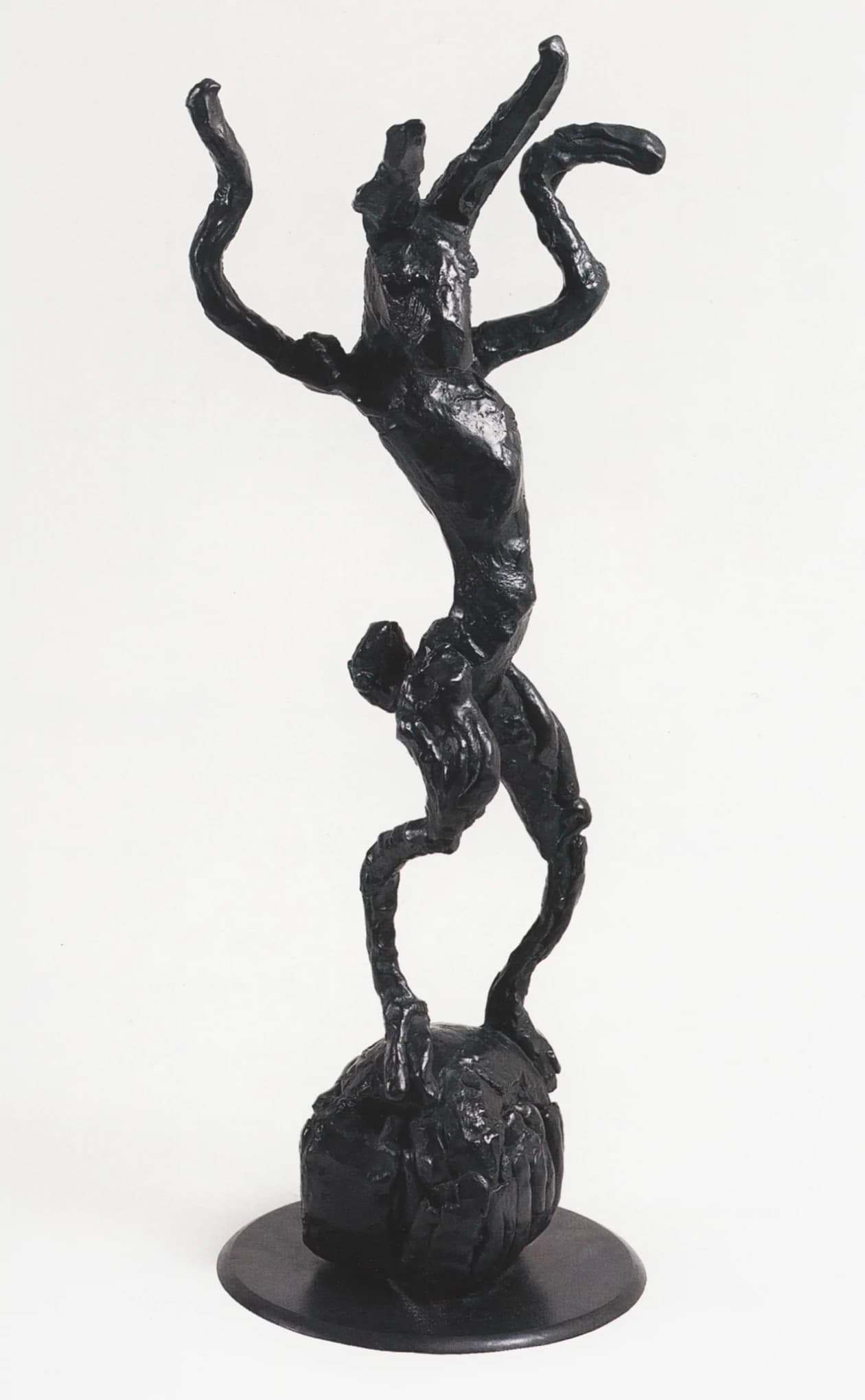
The early sculptures often allowed materials to behave according to their own physical properties: sand sagged, cloth folded, rope coiled. This openness to chance never disappeared. When Flanagan turned increasingly to bronze in the 1970s, modeling animals and figures by hand, the surfaces retained the pressure and spontaneity of making.
The hare emerged as his defining subject around 1979. Its associations with speed, fertility, trickery, transformation, and the moon gave Flanagan an elastic symbolic form. Human postures and cultural references - from Shakespeare and Nijinsky to boxing and musical performance - animate the animals without diminishing their strangeness.
An evolving legacy
Flanagan's career is remarkable for the apparent rupture and underlying continuity between his experimental soft sculptures and his later bronzes. Both bodies of work test movement, balance, material behavior, and the viewer's imaginative response. The hares made sculpture approachable to a broad public, yet their humor is inseparable from sophisticated questions about metamorphosis, monumentality, and the history of bronze.
He participated in landmark exhibitions including When Attitudes Become Form and Op Losse Schroeven in 1969. In 1982 he represented Britain at the Venice Biennale and exhibited at Documenta 7.
Institutional recognition
Flanagan's work is held in major international museums, including Tate, the Museum of Modern Art, and the Centre Pompidou, and his monumental sculptures have been installed in prominent public settings from London and Dublin to New York and Chicago. The Estate of Barry Flanagan supports research and the preservation of his archive, while leading international galleries continue to present the work.
Collector's market context
Flanagan's market includes early conceptual works, works on paper, ceramics, small bronzes, and monumental sculpture. The bronze hares are the most widely recognized and actively traded, with value shaped by model, scale, edition, date of cast, foundry, provenance, and condition. Lifetime casts and well-documented early examples warrant particular attention. Collectors should verify edition details and casting history carefully, as multiple scales and editions may exist for related compositions. The combination of museum importance and broad public recognition sustains international interest across both institutional and private contexts.