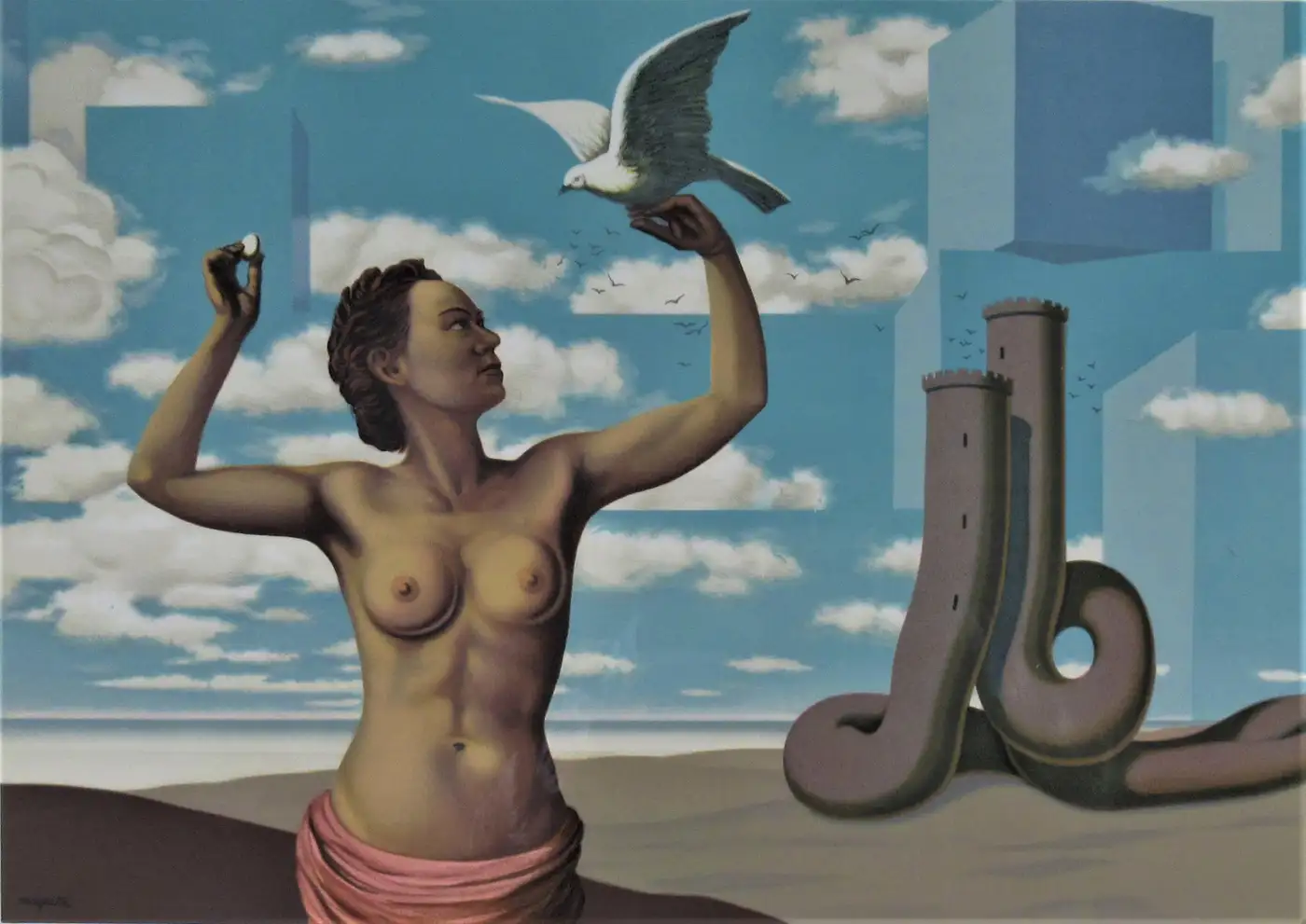
Belgian · 1898–1967 · Surrealism
Rene Magritte
Secondary Market
René François Ghislain Magritte was born in Lessines, Belgium, in 1898. He studied at the Académie Royale des Beaux-Arts in Brussels and worked in advertising and graphic design during the early development of his career. After encountering the work of Giorgio de Chirico, Magritte recognized the possibility of painting as a vehicle for poetic thought. He became a central figure in Belgian Surrealism, working closely with writers and intellectuals including Paul Nougé and Louis Scutenaire.
Magritte lived briefly in Paris from 1927 to 1930, engaging with the Surrealist circle around André Breton, before returning to Brussels. He died in 1967.
Continue reading +Show less −
Practice and methodology
Magritte's technique is deliberately controlled and impersonal. Smooth surfaces and legible objects allow the conceptual disturbance to take precedence over painterly expression. He employed displacement, transformation, scale shifts, substitution, concealment, and contradiction. A room fills with an enormous apple; daylight and night coexist; a face is hidden by fruit; a painted landscape both reveals and blocks the landscape beyond.
Language is equally central. The Treachery of Images, with its declaration that the painted pipe is not a pipe, exposed the difference between an object and its representation. Magritte returned to motifs in multiple versions, treating each as a durable philosophical proposition rather than a single fixed image.
An evolving legacy
Magritte's influence extends across conceptual art, Pop, advertising, film, photography, music, and contemporary visual culture. His restraint and accessibility allowed complex ideas about perception and language to circulate far beyond Surrealism. The work remains uncannily current because it addresses the unstable relationship between an image and the reality it claims to show.
Major retrospectives have been organized by museums worldwide, and focused exhibitions continue to reveal less familiar periods, including his experimental Renoir and vache works and his sustained engagement with landscape.
Institutional recognition
The Musée Magritte Museum in Brussels holds the world's largest collection of his work. Major holdings are also found at the Menil Collection, the Museum of Modern Art, the Art Institute of Chicago, Tate, the Israel Museum, and other leading institutions. The Magritte Foundation and Magritte Committee provide resources related to documentation and authentication.
Collector's market context
Magritte stands at the summit of the international Surrealist market. In 2024, L'empire des lumières achieved $121.2 million at auction, setting a new record for the artist. Market value is highly sensitive to motif, date, scale, medium, provenance, exhibition history, and the relationship of a work to canonical series. Major oils with recognized imagery form a rarefied category, while gouaches, drawings, prints, and later editions require medium-specific evaluation. Authentication, inclusion in the catalogue raisonné or authoritative documentation, and complete provenance are essential to acquisition diligence.