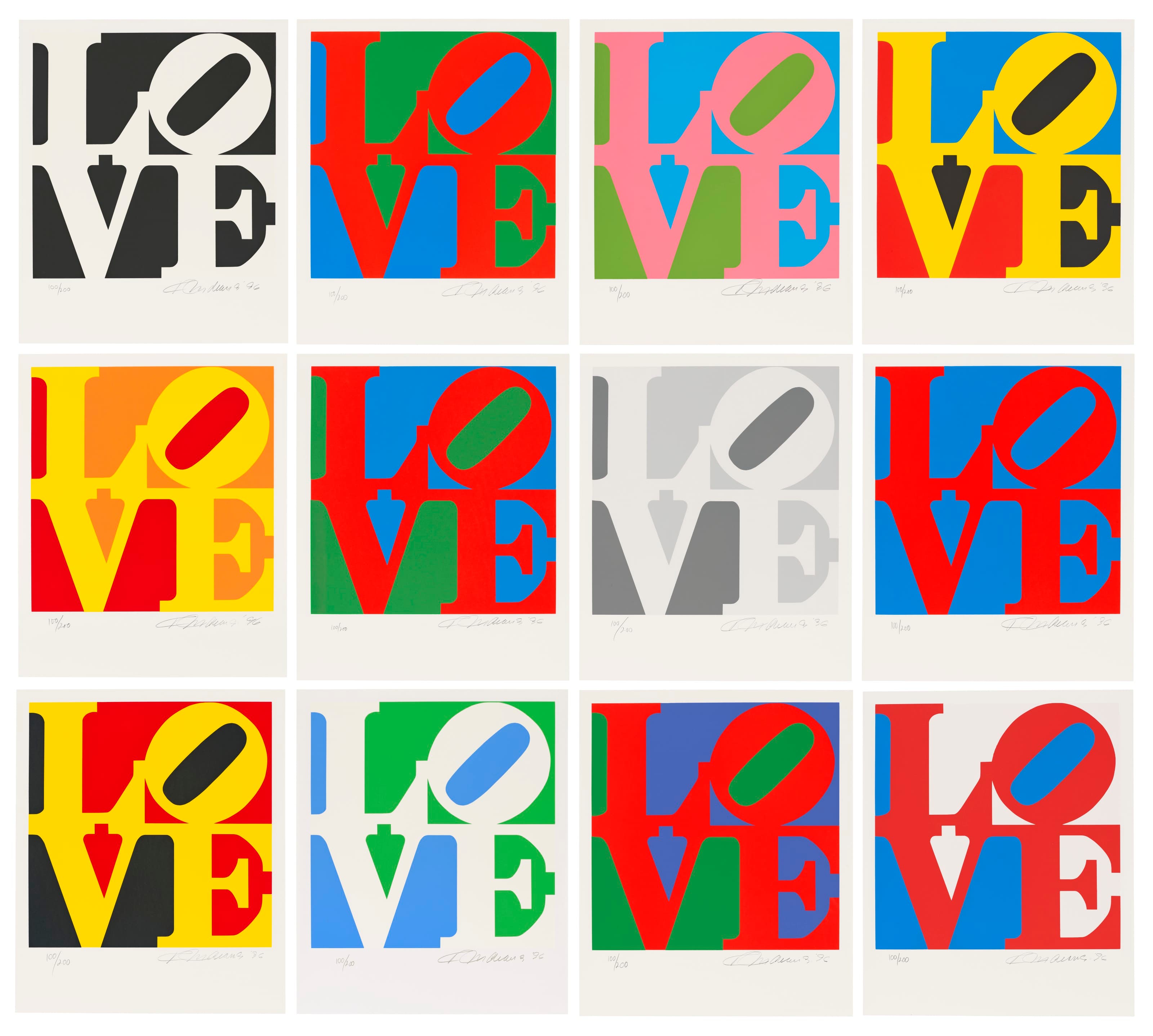
American · 1928–2018 · Pop Art · Estate
Robert Indiana
Secondary Market
Born Robert Clark in New Castle, Indiana, in 1928, the artist adopted the name of his home state after moving to New York. He studied at the School of the Art Institute of Chicago and continued his education in Maine and Europe. In the 1950s he settled at Coenties Slip in Lower Manhattan, joining a community that included Ellsworth Kelly, Agnes Martin, James Rosenquist, and Jack Youngerman.
Found maritime timbers, stenciled numbers, industrial signs, and the architecture of the Slip helped shape his early assemblages and paintings. In 1978 Indiana moved to Vinalhaven, Maine, where he lived and worked until his death in 2018.
Continue reading +Show less −
Practice and methodology
Indiana described himself as a painter of signs. Words such as LOVE, EAT, DIE, HOPE, and ART appear in symmetrical arrangements that resemble logos while carrying personal and cultural associations. Numbers refer to highways, addresses, dates, and stages of life. Circles, stars, polygons, and bold color create structures that are immediate at a distance and layered upon sustained viewing.
The first LOVE images developed in the mid-1960s, including a Museum of Modern Art Christmas card, and soon moved across paintings, prints, sculptures, stamps, and public commissions. Indiana returned repeatedly to the motif, translating it into other languages and contexts. Yet works such as the American Dream and EAT/DIE series reveal a darker reflection on consumerism, mortality, and national mythology.
An evolving legacy
Indiana's public familiarity sometimes obscured his conceptual rigor. Recent exhibitions and scholarship have restored attention to the autobiographical and political dimensions of his practice and to his role in assemblage, hard-edge painting, and text-based art. His work anticipated the widespread use of language by later conceptual and contemporary artists while remaining grounded in the visual culture of mid-century America.
Institutional recognition
Indiana's work is held in major museums internationally and appears in public spaces around the world. Collections include the Museum of Modern Art, the Whitney Museum of American Art, the Smithsonian American Art Museum, the Menil Collection, Crystal Bridges Museum of American Art, and many others. The Robert Indiana Legacy Initiative supports scholarship and public understanding of the artist's work.
Collector's market context
Indiana's market ranges from unique paintings and sculptures to prints, multiples, and posthumous or publisher-related objects whose status can differ considerably. Major paintings from the 1960s and historically important sculptures occupy a distinct category from widely distributed editions. Title, date, medium, edition, publisher, fabrication history, provenance, and inclusion in authoritative records are essential. Recent litigation concerning unauthorized and forged works has made documentary diligence especially important. Collectors should verify that the object, signature, edition, and publisher align with recognized cataloguing and rights-holder information.